
Your Skin Can Rebuild Itself. Here's How We Help It.
A guide to collagen biostimulators — PLLA and CaHA — and why their combination with Endolift represents the most intelligent approach to facial rejuvenation available today.
READ TIME: 5 minutes
CATEGORY: Regenerative Aesthetics
There is a question I hear often, though it is rarely put quite so plainly: "Is there a way to look better without looking like I've had something done?"
The answer, increasingly, is yes and it lies not in adding more to the face, but in prompting the face to restore itself.
This is the principle behind collagen biostimulation. And when combined with Endolift, it forms what I consider the most sophisticated and genuinely natural rejuvenation protocol available in aesthetic medicine today.
First: Understanding What Ageing Actually Does
Youthful skin is not simply smooth skin. It has density, a richness of collagen fibres in the dermis that give it that slightly pillowed quality, the impression of being supported from within. From our mid-thirties onwards, collagen production begins to decline at a rate of roughly one to two per cent per year. The fat compartments of the face gradually lose volume. The fibrous connective tissue that once held everything taut begins to relax.
The result is not dramatic, at first. It is subtle. A softening of the jaw. A slight hollowing of the temples. A tiredness around the eyes that no amount of sleep seems to resolve. Patients describe looking in the mirror and not quite recognising themselves, not because they look old, but because they no longer look as vital as they feel.
Collagen biostimulators address this at its biological source.
What Is a Collagen Biostimulator?
Unlike conventional dermal fillers, which occupy space and provide immediate volumisation, collagen biostimulators work by triggering the skin's own regenerative processes. When introduced into the deep dermis or subcutaneous tissue, they stimulate fibroblasts — the cells responsible for producing collagen — to lay down new collagen fibres over time.
The change is not immediate. It unfolds over weeks and months. This is not a disadvantage; it is precisely what makes the outcomes look so natural. The improvement is progressive, cumulative, and entirely your own biology at work.
There are two principal categories of biostimulator that I use in my practice, each with a distinct mechanism and character.
Poly-L-Lactic Acid (PLLA): Sculptra and Juläine
PLLA (Poly-L-Lactic Acid) is the most established of the biostimulatory agents, with over two decades of clinical use and an excellent safety record. Two products in this category are available at my practice: Sculptra, the long-standing gold standard, and Juläine, a newer-generation PLLA developed by Swedish biotech company Nordberg Medical.
Both products work by the same fundamental mechanism. Injected as a suspension into the deep dermis and subcutaneous tissue, PLLA particles act initially as a scaffold. The body responds to their presence as it would to any biodegradable foreign body by surrounding them with new collagen. As the PLLA is gradually metabolised and absorbed, typically over twelve to eighteen months, what remains is a matrix of the patient's own collagen. Their face, rebuilt from within.
Where Juläine distinguishes itself is in the precision of its formulation. Its proprietary LaSynPro technology produces highly uniform, high-purity microspheres with a smaller, more consistent particle size than older-generation PLLA. This means they disperse more evenly in the tissue, degrade more predictably, and critically avoid the clumping that has historically been a consideration with PLLA-based products. The result is a smoother, more controlled collagen response.
The areas most responsive to PLLA biostimulation are those characterised by volume deflation: the temples, the mid-face and cheeks, the pre-jowl sulcus, and the subtle hollowing beneath the eyes. A typical protocol involves two to three treatment sessions, spaced six to eight weeks apart. Results, once established, can be maintained for two years or more.
The choice between Sculptra and Juläine is something I discuss with each patient individually. Both are excellent products; the decision depends on anatomy, treatment goals, and the specific collagen response we are seeking to achieve.
Calcium Hydroxyapatite (CaHA): Radiesse
Radiesse occupies a different but complementary position in the biostimulator landscape. Its active component (microspheres of calcium hydroxyapatite suspended in a gel carrier) provides immediate structural support on injection, which distinguishes it from pure PLLA-based products.
This dual action is Radiesse's particular strength. The gel carrier gives an immediate degree of volumisation and lift. As it is gradually absorbed by the body over the following months, the CaHA microspheres remain in situ, acting as a biostimulatory framework that encourages the surrounding tissue to produce new collagen and elastin. The volumising effect transitions, over time, into a genuine regenerative one.
Radiesse performs particularly well in areas where laxity and textural change coexist. The lower face and jawline, the neck, and the décolletage are regions where it consistently delivers meaningful improvement. It also has a well-documented lifting characteristic that makes it a valuable tool when mild structural reinforcement is part of the treatment objective.
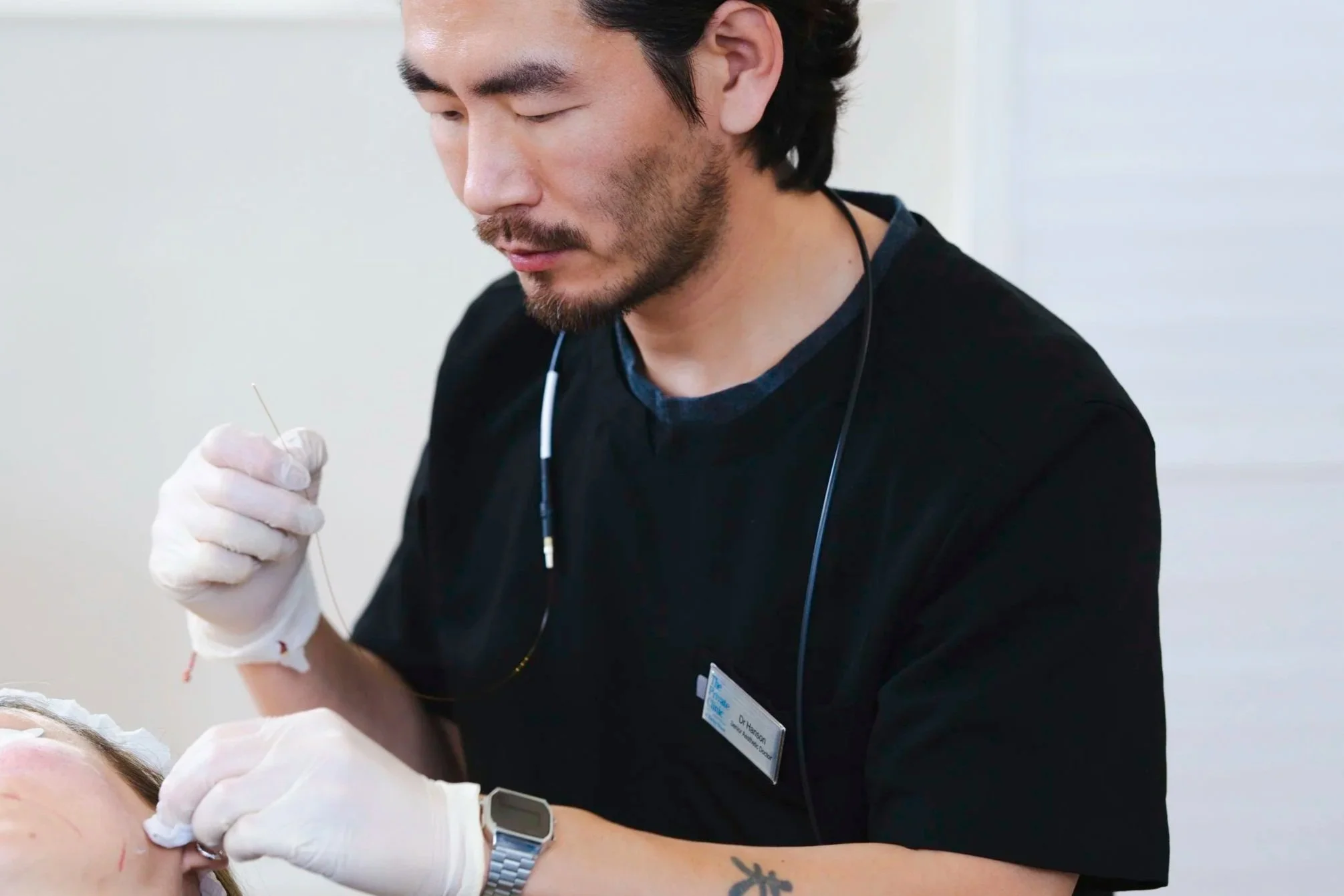
Dr Hanson Performing Endolift Treatment
Endolift: Preparing and Perfecting the Canvas
To understand why combining biostimulators with Endolift produces results that neither achieves alone, it helps to think about what each is doing at a tissue level.
Biostimulators rebuild the architecture beneath the skin the collagen scaffolding and volume framework. Endolift addresses the skin itself and the tissue immediately beneath it.
Endolift is a minimally invasive laser procedure performed through a fibre-optic filament introduced sub-dermally (as thin as hair strands) through a tiny entry point. The laser energy it delivers has three precise effects: it melts localised deposits of subdermal fat that contribute to heaviness and jowling; it contracts and tightens the fibrous septae, the connective tissue bands that anchor the skin; and it induces a controlled thermal stimulus that triggers further collagen production in the dermis itself.
The areas where I find Endolift most transformative are the lower face and jowl line, the neck, the submental region beneath the chin, and the delicate malar area, precisely the zones where patients most commonly describe looking older than they feel. The outcome, when performed well, is a lifted, tightened quality that is entirely imperceptible in origin. Patients are not asked what they have had done. They are told they look well. Rested. Like themselves.
The Combined Protocol: Intelligence Over Volume
The real clinical artistry lies in understanding how these modalities interact and in sequencing them to maximise what each can achieve.
My typical approach to a combined biostimulation and Endolift protocol is as follows, though every plan begins from an individual assessment:
Stage one: Endolift. I generally prefer to begin with Endolift. The laser energy creates a state of active tissue remodelling; the body is already recruiting its regenerative resources. Introducing biostimulatory agents into this environment may potentiate the overall collagen response, as multiple regenerative stimuli arrive in close succession.
Stage two: Biostimulator injection. Once the Endolift result has settled, typically four to six weeks post-procedure, PLLA (Sculptra or Juläine) or Radiesse are introduced into the areas of volume deficit and collagen loss. The Endolift has tightened the overlying skin; the biostimulators now rebuild the framework beneath it. Each reinforces the other.
Stage three: Review and refinement. At subsequent consultations, we assess the evolving result together. In some cases, a small amount of conventional filler may be used to refine a specific area with precision. More often, the combined result of Endolift and biostimulation renders this unnecessary.
The underlying philosophy is one I return to consistently: the goal is never to fill or lift aggressively. It is to understand what your face has lost, and to restore it through the most intelligent biological means available.
Who Is Best Suited to This Approach?
Patients who respond most beautifully to this combined protocol are typically in their forties, fifties, and sixties, those who have noticed a gradual change in facial density, definition, and skin quality, but who are not seeking dramatic transformation. They want to look like themselves. A version of themselves that feels more congruent with their energy and their vitality.
These are patients who are discerning. They have researched carefully. They are not looking for the most filler or the most aggressive treatment. They are looking for the most considered one.
They are also, in my experience, patient. And patience is rewarded here. The most compelling results I have witnessed from this protocol come from individuals who trusted the process, attended their follow-up appointments, and allowed their biology the months it needed to respond fully.

Before and After Images Presenting Elegant Result after Sequencing of Treatments
Practical Considerations
Both PLLA and CaHA injections are well-tolerated under topical anaesthetic. Endolift is performed under local anaesthesia. There will be some swelling, and occasionally mild bruising, in the days following each session; most patients return to normal life within one to two days. There is no general anaesthetic, no surgical incision, and no prolonged recovery.
What I ask of every patient beginning this kind of programme is simply an honest conversation about what they want, what their face needs, and what a realistic timeline looks like. That conversation is where all good work begins.
If you would like to explore whether a collagen biostimulation protocol, with or without Endolift, is the right approach for you, I invite you to arrange a consultation at my Harley Street practice.
Dr. Hanson | Harley Street, London
