
Polynucleotides and Sunekos for Under-Eye Skin: How to Choose the Right Treatment
The under-eye area is one of the most delicate and difficult areas to treat in aesthetic medicine. The skin is thin, highly mobile, and closely related to deeper structures such as fat pads, ligaments, vessels and bone. This is why under-eye concerns can have many different causes, including skin thinning, dehydration, pigmentation, hollowing, eye bags, fluid retention or early laxity.
Polynucleotides and Sunekos are both injectable skin-quality treatments used around the under-eye area. They are not traditional dermal fillers and are not designed primarily to add volume. Instead, they aim to improve the quality of the skin itself.
How to Choose the Right Treatment - Polynucleotides or Sunekos?
What are Polynucleotides?
Polynucleotides are highly purified DNA fragments used in aesthetic medicine for their regenerative and tissue-repair properties. They are usually derived from fish DNA and are injected superficially into the skin.
In aesthetic practice, polynucleotides are used to support skin repair, hydration, elasticity and texture. They are particularly useful when the under-eye area appears thin, fragile, crepey or tired due to poor skin quality rather than volume loss.
Polynucleotides are often described as a regenerative treatment because their biological rationale is linked to tissue repair, wound healing and extracellular matrix support. This makes them especially interesting when the clinical aim is to improve skin resilience rather than simply fill a hollow.
What is Sunekos?
Sunekos is an injectable treatment containing hyaluronic acid combined with a specific mixture of amino acids. Hyaluronic acid helps support hydration, while amino acids act as building blocks involved in the skin’s extracellular matrix.
Around the under-eye area, Sunekos may help improve hydration, fine lines, mild crepiness and tired-looking skin. It is best understood as a skin-booster or skin-quality treatment rather than a volumising filler.
How do you choose between Polynucleotides and Sunekos?
The correct treatment depends on the underlying cause of the under-eye concern.
Polynucleotides may be more suitable when the main issue is thin, crepey, fragile or poor-quality skin. They may also be useful when the aim is regenerative improvement, tissue repair and gradual strengthening of the skin.
Sunekos may be more suitable when the under-eye area looks dehydrated, dull, finely lined or tired, especially when the concern is mild and related to skin hydration or texture rather than deeper anatomy.
If the main issue is hollowing or shadowing caused by volume loss, tear-trough filler or mid-face filler may be more appropriate. If the main issue is prominent eye bags, festoons, significant skin laxity or excess skin, injectable skin-quality treatments alone are unlikely to be sufficient. In those cases, energy-based devices, laser resurfacing or surgical assessment may be more suitable.
If pigmentation is the main concern, polynucleotides or Sunekos may have limited effect, because pigmentation often requires targeted skincare, laser or other pigment-specific treatment.
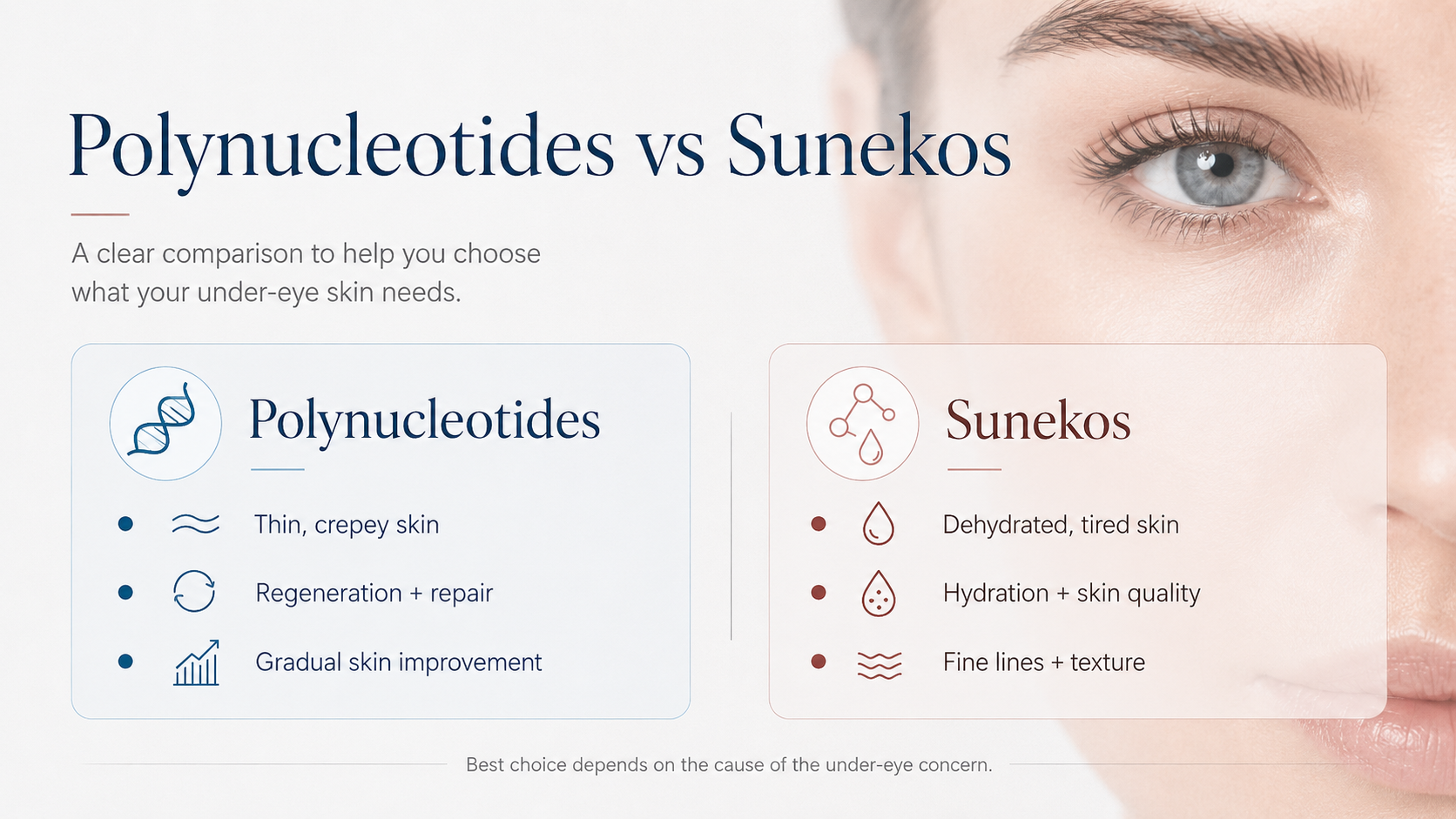
Polynucleotides vs Sunekos
Do Polynucleotides work well with devices?
Polynucleotides have a strong regenerative and tissue-repair rationale, so they may be particularly useful as part of a wider skin-regeneration programme. This can include treatments that create controlled micro-injury, such as microneedling, laser or radiofrequency, where the purpose is to stimulate healing, collagen remodelling and skin renewal.
However, it is important not to overstate this. While the biological rationale is sound, direct clinical evidence proving that polynucleotides work better with devices specifically for under-eye rejuvenation is still limited. In practice, the decision to combine treatments should depend on the patient’s skin quality, tolerance for downtime, risk of pigmentation, anatomy and treatment goals.
What can these treatments achieve?
Polynucleotides and Sunekos may help improve:
fine lines
crepey skin
skin hydration
skin texture
mild laxity
tired-looking under-eye skin
overall skin quality
They are gradual treatments. Results usually develop over several weeks and a course of sessions is often required. They are not designed to produce an instant structural change in the way that dermal filler can.
What are the limitations?
These treatments cannot reliably correct all under-eye concerns.
They will not remove significant eye bags. They will not surgically tighten loose skin. They will not fully correct deep tear-trough hollowing if the problem is structural volume loss. They may also have limited effect on true pigmentation, especially if the darkness is caused by melanin, vascular visibility or genetic factors.
The most natural results come from correctly diagnosing the cause of the under-eye concern before choosing the treatment.
Downtime and side effects
Downtime is usually mild but the under-eye area is delicate and can bruise easily.
Immediately after treatment, small bumps, redness, swelling or tenderness may be visible. These usually settle within 24–48 hours. Bruising can occur and may take several days to a week to resolve.
Less common risks include prolonged swelling, lumpiness, infection, allergy or an unsatisfactory cosmetic outcome. As with all injectable treatments, careful patient selection, anatomy knowledge and conservative technique are important.
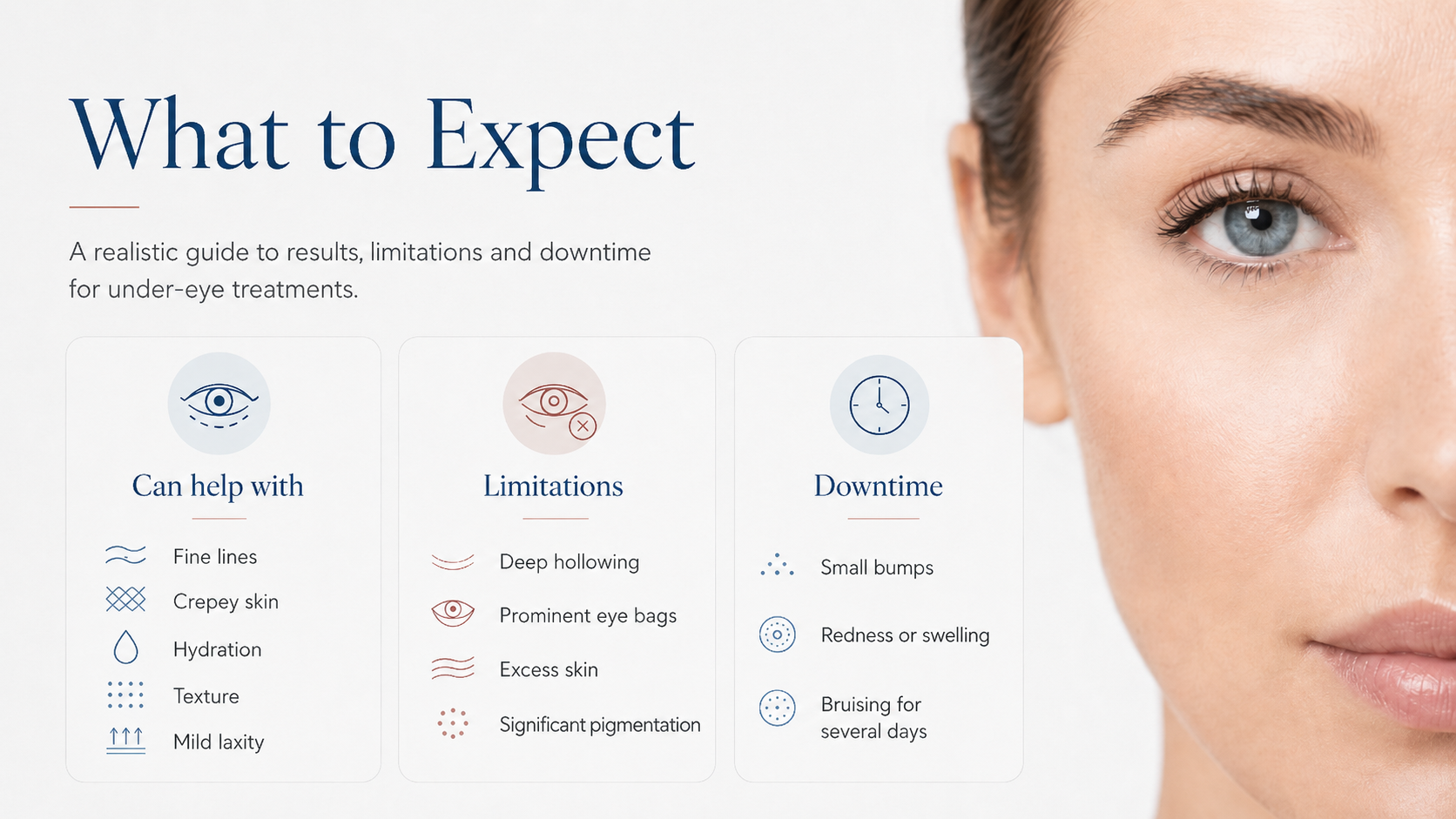
What to expect after Polynucleotides and Sunekos
Summary
Polynucleotides and Sunekos are both useful options for improving under-eye skin quality, but they are not interchangeable and they are not suitable for every under-eye concern.
Polynucleotides are generally more suited to thin, fragile, crepey or poor-quality skin where the aim is regeneration and tissue repair.
Sunekos is generally more suited to dehydration, fine lines, mild crepiness and tired-looking skin where hydration and skin quality are the main goals.
For hollowing, eye bags, pigmentation or significant laxity, other treatments may be more appropriate. A careful consultation is essential to identify the true cause before deciding on the best approach.
