
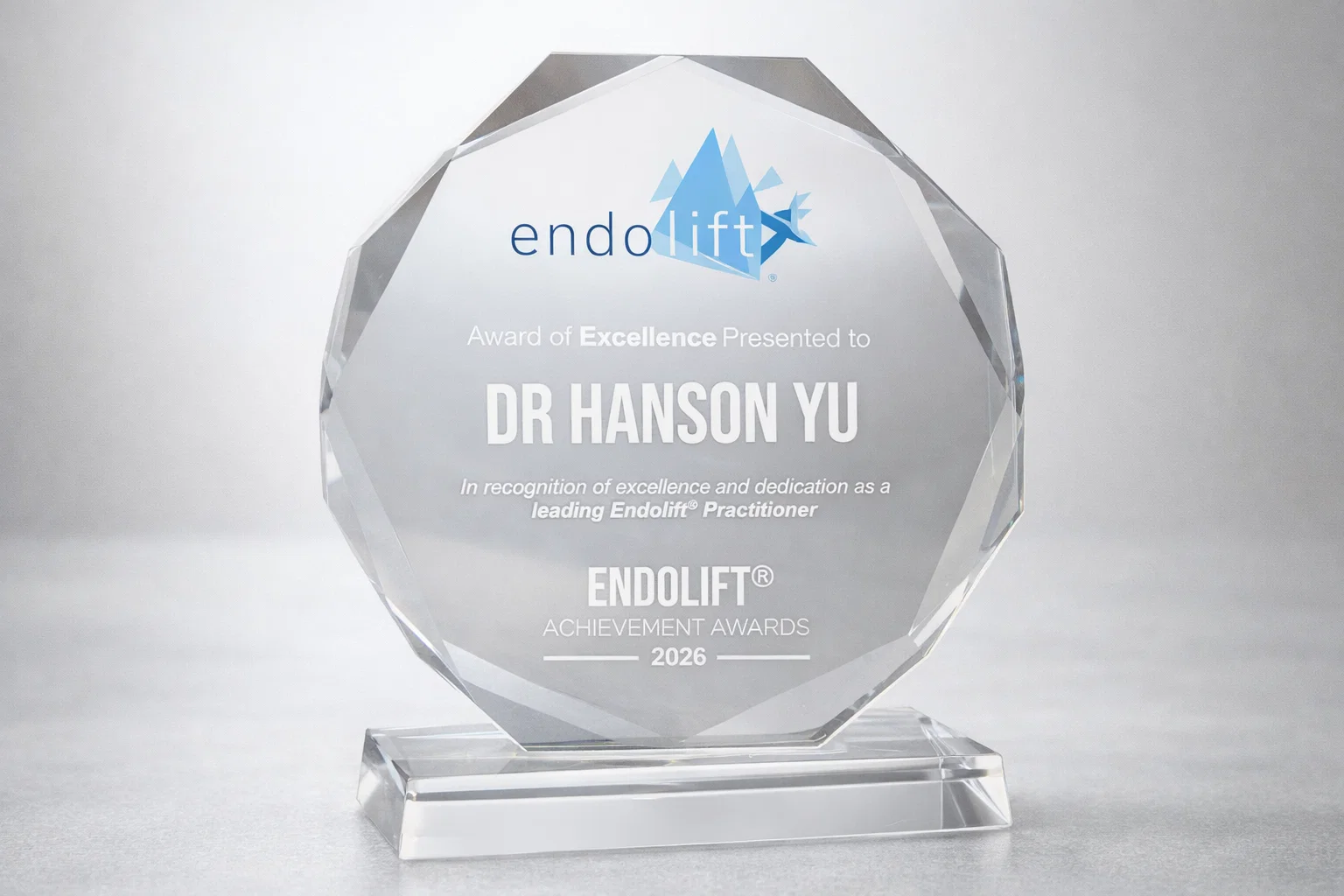
Dr Hanson Clinic Wins Endolift® Award of Excellence 2026
There is a point in aesthetic medicine where injectables begin to fall short, and surgery feels disproportionate. It is in that space that Endolift exists, not as a replacement, but as an intervention that works within the structure of the face rather than around it.
Dr Hanson Clinic has been awarded the Endolift® Award of Excellence 2026, recognising not simply the use of the technology, but the way in which it is applied. The distinction is subtle, but important. Endolift is widely available. Consistent outcomes are not.
The treatment itself operates beneath the surface, within the fibro-septal network, the underlying architecture that determines how tissue holds, shifts, and ages over time. Through a micro-optical fibre, laser energy is delivered directly into this structure. Not broadly, and not diffusely, but with control. The effect is gradual. Tightening and remodelling that does not alter the identity of the face, but restores its coherence.
In this context, technology is constant. The variable is judgment.
Depth, direction, placement, and restraint. These are not technical details alone, but decisions that determine whether a treatment integrates into the face or sits visibly on top of it. Endolift is not designed to create volume or exaggeration. It supports structure. When applied without discipline, it becomes noticeable. When applied correctly, it does not.
This is where the distinction of practice becomes clear. Endolift is rarely positioned as a starting point. More often, it sits between stages, where injectables are no longer sufficient, yet surgical intervention remains unnecessary. Navigating that space requires planning, not only in the moment of treatment, but across time.
The face does not change suddenly. It shifts incrementally. Treatments that respect this tend to age better.
Within that framework, Endolift treatment becomes part of a wider approach, one that considers balance, tissue quality, and the trajectory of ageing rather than isolated correction. It is less about intervention and more about alignment.
Recognition, in this context, reflects something narrower than visibility. It reflects the application. A consistent approach to when to intervene, how to intervene, and when not to.
Awards often follow exposure. This one reflects control.
In a field shaped by rapid innovation and increasing access to technology, it is a reminder that outcomes are not defined by the device itself, but by the discipline behind its use. Precision, applied over time, remains the determining factor.
And increasingly, it is this approach, quieter, more measured, less visible, defining the direction of aesthetic practice.